
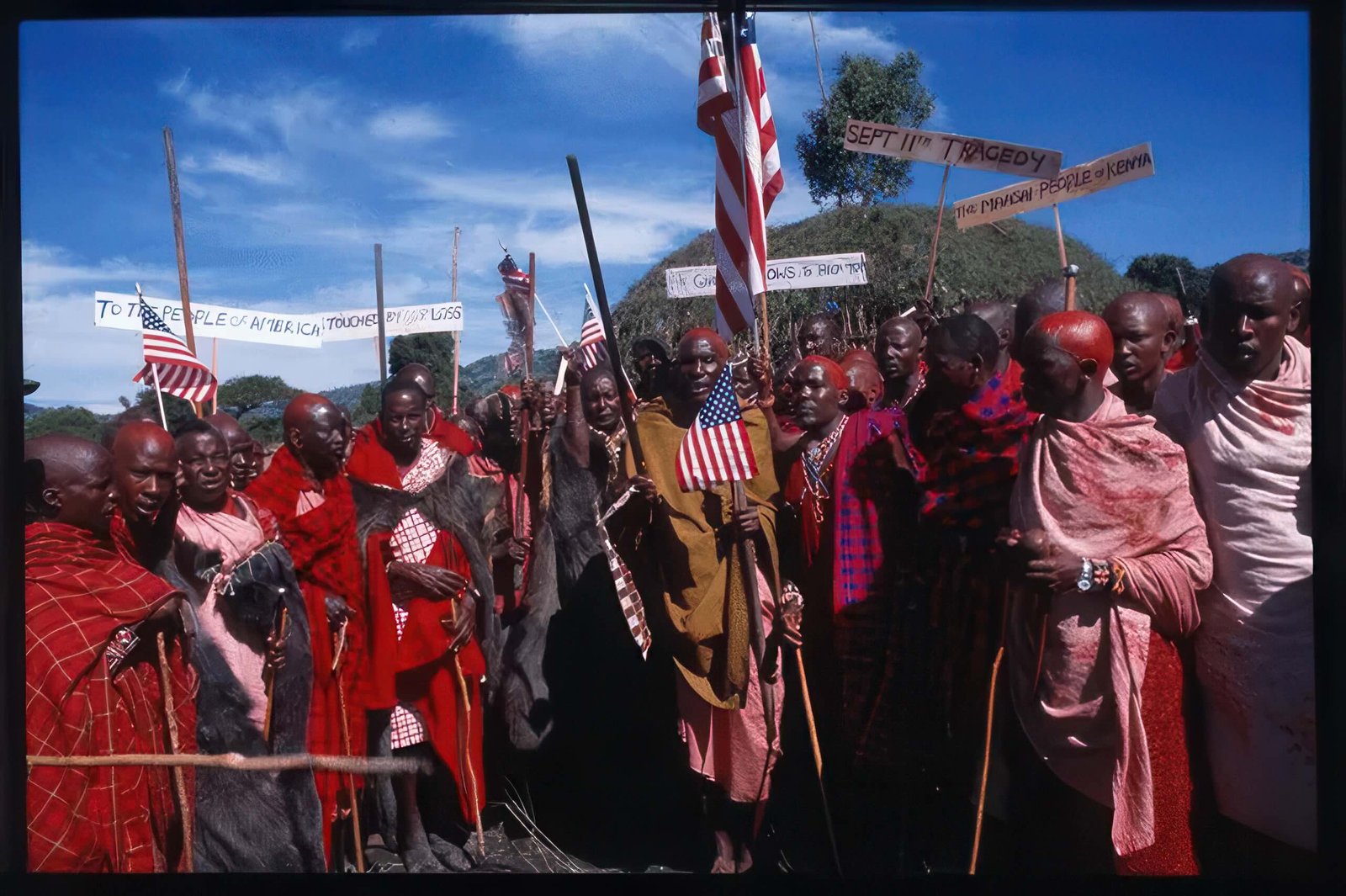
In June 2002, nine months after the September 11th attacks, a remarkable ceremony took place in a remote village in western Kenya. Hundreds of Maasai warriors, dressed in traditional red robes, gathered around an American diplomat. They were there to give a gift to a grieving nation half a world away. The gift was fourteen cows.
The idea came from a young Maasai man named Wilson Kimeli Naiyomah. In 2001, Naiyomah was studying medicine at Stanford University on a scholarship. When the planes hit the World Trade Center, he happened to be in New York. He saw the towers fall. He saw the ash covering the streets. He carried that memory with him back to his village in Enoosaen, Kenya, about six months later.
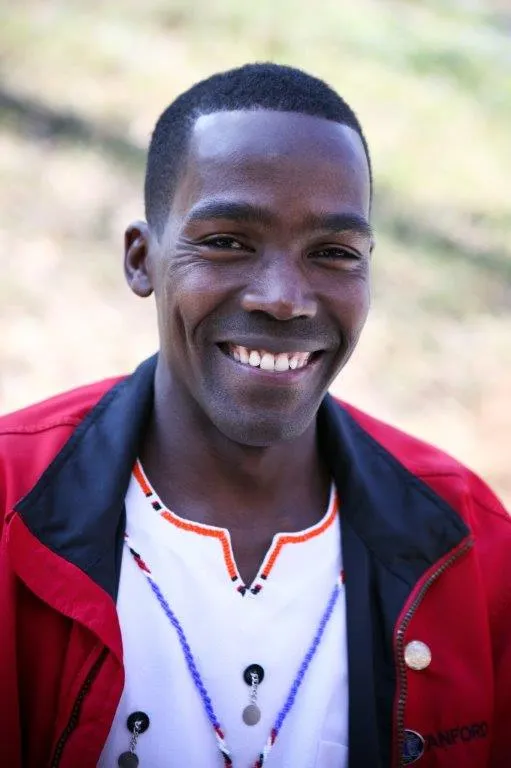
Naiyomah told his elders what he had witnessed. The Maasai had no television, no radio. Many had no electricity. For them, the World Trade Center was an unfamiliar name. But they understood grief. They understood loss. They understood that a nation was hurting.
In Maasai culture, the cow is central to life. It represents wealth, sustenance, and spiritual well-being. Giving a cow is the highest form of generosity, equivalent to giving a child or a piece of land. Naiyomah asked his elders for permission to offer his own cow as a gift to America. The elders considered the request. Then they added thirteen more. Fourteen sacred cows, offered to a people they had never met.
The ceremony took place in June 2002, nine months after the attacks. Hundreds of Maasai gathered. They surrounded the American ambassador, William Brancick, and presented the gift. The cows, they explained, were meant as “a handkerchief to dry Americans’ tears”.
The U.S. government faced a dilemma. Transporting fourteen cows from rural Kenya to America was impractical. The climate was unsuitable for the animals. The logistics were impossible. The cows could not be slaughtered, as they had become sacred. The gift was accepted in spirit, but the cows remained in Kenya.
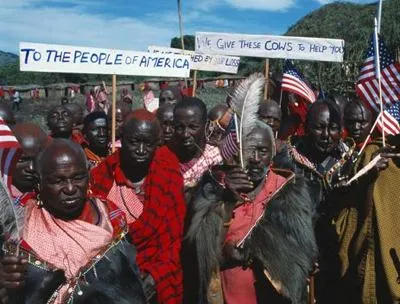
For four years, the sacred cows grazed in Enoosaen. They were never killed. The herd grew. By 2006, there were twenty-seven cows. Some Maasai were displeased that the American government had not taken the cows, seeing it as a slight. But the ambassadors assured them the gift was deeply appreciated.
In 2006, U.S. ambassador William Bellamy traveled to Enoosaen to formally thank the Maasai. He announced that the United States would fund fourteen scholarships for Maasai students. It was a reciprocal gift, a gesture that honoured the original sacrifice. Bellamy told the crowd that the gift had strengthened the bond between Kenya and the United States.
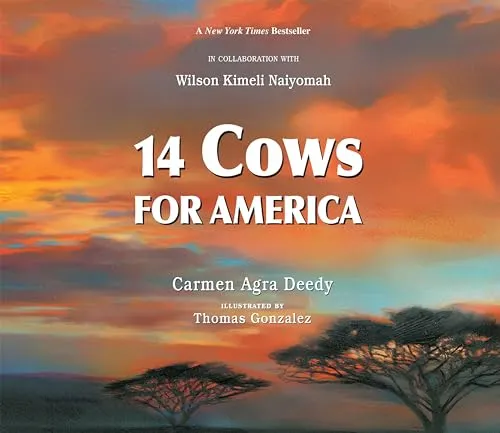
The story of the Maasai gift traveled around the world. It became the subject of a New York Times bestselling children’s book, “14 Cows for America,” written by Carmen Agra Deedy in collaboration with Naiyomah and illustrated by Thomas Gonzalez. The book introduced the story to millions of readers.
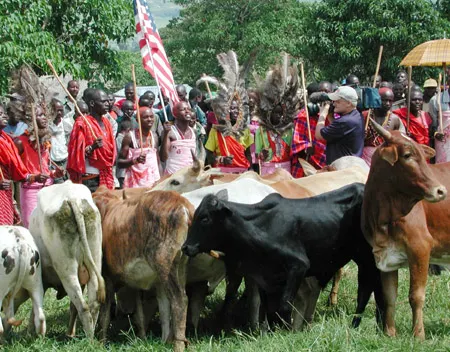
For the Maasai, the gift was never about publicity or politics. It was about compassion. They had little, but they gave what they had. As Naiyomah explained, “I wanted to give something that was meaningful, something that would bring comfort. The cow is life to us. We wanted to give life”.
The Maasai people of Enoosaen demonstrated that generosity is not measured by abundance. A tribe with no television, no radio, and only recently acquired electricity reached across the ocean to comfort a nation in mourning. They offered fourteen cows, and in doing so, they offered a piece of their own life. For Americans, the gift emerged “from the choking dust and darkness as a soft light of hope and friendship”.
The cows still graze in Kenya. Their herd has grown. And their story remains a testament to the power of simple, selfless compassion.
Sources:
- ABC Evening News, “Kenya / Gift / September 11,” 3 June 2002. Vanderbilt Television News Archive. https://tvnews.vanderbilt.edu/broadcasts/702309
- Carmen Agra Deedy and Wilson Kimeli Naiyomah, 14 Cows for America (Peachtree Publishers, 2009).
- BBC Chinese, “肯尼亚部落里的’美国牛’,” 8 October 2006. http://news.bbc.co.uk/chinese/simp/hi/newsid_6030000/newsid_6033800/6033897.stm
- The Age, “Simple Masai gift touches America,” 3 July 2004. https://www.theage.com.au/national/simple-masai-gift-touches-america-20040703-gdy5wn.html
- First Channel (Russia), “В знак сочувствия к жертвам трагедии 11 сентября кенийское племя преподнесло США 14 священных коров,” 4 June 2002. https://www.1tv.ru/news/2002-06-04/266826
- BBC Russian, “Коровы в знак сочувствия,” 3 June 2002. http://news.bbc.co.uk/hi/russian/news/newsid_2023000/2023195.stm
- 7. Voz de América, “Vacas Sagradas para EE.UU.,” 3 June 2002. https://www.vozdeamerica.com/a/a-2002-06-03-19-1/12137.html
Verification Table
| Key Fact | Source & Context | Status |
| Wilson Kimeli Naiyomah is a Maasai tribesman from Enoosaen, Kenya | ABC Evening News; BBC Chinese | Verifiable |
| Naiyomah was studying medicine at Stanford University on a scholarship | BBC Chinese; The Age | Verifiable |
| He was in New York on 11 September 2001 and witnessed the attacks | BBC Chinese | Verifiable |
| He returned to his village in Kenya about six months later | BBC Chinese | Verifiable |
| He told the Maasai elders about what he had seen in New York | BBC Chinese; The Age | Verifiable |
| Many villagers had no telephone, electricity, or television at the time | First Channel (Russia); BBC Russian | Verifiable |
| The idea to give cows came from Naiyomah | BBC Chinese; The Age | Verifiable |
| He asked permission to offer his one cow | BBC Chinese; Achievethecore.org | Verifiable |
| The elders decided to offer 14 cows total | BBC Chinese; The Age | Verifiable |
| In Maasai culture, the cow is the most valuable gift, representing life | BBC Chinese; Achievethecore.org | Verifiable |
| Giving a cow is equivalent to giving a child or a piece of land | BBC Chinese | Verifiable |
| The ceremony took place in Enoosaen, western Kenya, in June 2002 | The Age; Voz de América | Verifiable |
| The ceremony took place nine months after the 9/11 attacks | Google Books (14 Cows for America) | Verifiable |
| Hundreds of Maasai gathered, wearing traditional red robes | BBC Chinese; Voz de América | Verifiable |
| The American ambassador, William Brancick, accepted the gift | ABC Evening News; Voz de América | Verifiable |
| The cows were meant as “a handkerchief to dry Americans’ tears” | The Age | Verifiable |
| The U.S. government could not transport the cows to America | First Channel; BBC Russian | Verifiable |
| The cows remained in Kenya and were considered sacred | BBC Chinese | Verifiable |
| The cows were never slaughtered | BBC Chinese | Verifiable |
| By 2006, the herd had grown from 14 to 27 cows | BBC Chinese | Verifiable |
| In 2006, U.S. ambassador William Bellamy returned to Enoosaen | BBC Chinese; The Age | Verifiable |
| The U.S. announced 14 scholarships for Maasai students as a gesture of thanks | BBC Chinese; The Age | Verifiable |
| The story became a New York Times bestselling book, “14 Cows for America” | Google Books (multiple editions) | Verifiable |
| The book was written by Carmen Agra Deedy with Wilson Kimeli Naiyomah | Google Books | Verifiable |
Achievements, Awards & Commemorations
| Commemoration | Date | Details |
| 14 Cows for America (Book) | 2009 | New York Times bestselling children’s book by Carmen Agra Deedy with Wilson Kimeli Naiyomah; illustrated by Thomas Gonzalez |
| “Thanks for the Cattle” Website | c. 2002 | Website created by Americans to thank the Maasai; hosted at 14cattle.org |
| U.S. State Department Recognition | 2002 | The gift is registered on the State Department website alongside comments from world leaders on 9/11 |
| Scholarship Fund | 2006 | 14 scholarships announced for Maasai students by U.S. ambassador William Bellamy |
| Herd Growth | 2002-2006 | The original 14 sacred cows grew to 27; never slaughtered |