
Samuel Achilefu was born in northern Nigeria in 1963. When he was five years old, his family moved to the southeast of the country to escape the Nigerian Civil War . He grew up in a nation on the brink of transformation, and he would go on to transform medicine in ways no one could have predicted.
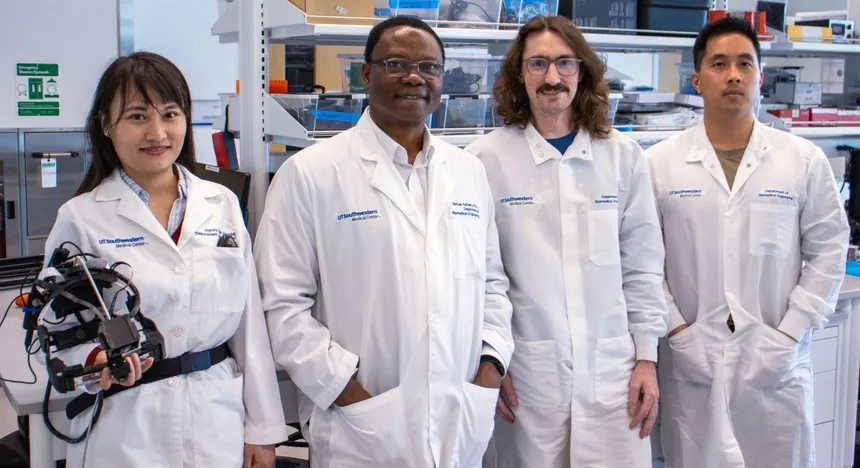
Today, Dr. Achilefu is the inaugural Chair of Biomedical Engineering at UT Southwestern Medical Center in Dallas. He holds the Lyda Hill Distinguished University Chair and is a member of the National Academy of Engineering, the National Academy of Medicine, and the National Academy of Inventors . He holds more than 70 U.S. patents. But his most famous invention is a pair of goggles.
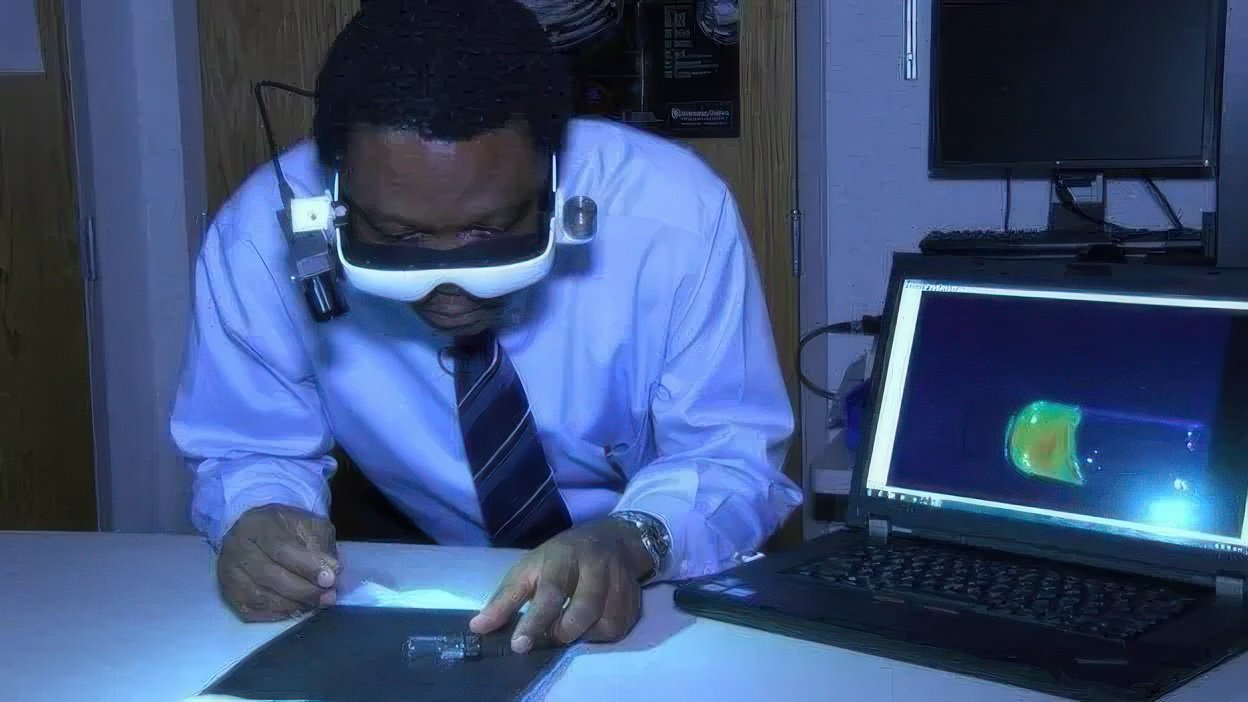
The Cancer Vision Goggles, or CVG, look like something a video gamer would wear . But they have a much higher purpose: they allow surgeons to see cancer cells glowing in real time during surgery. The technology works through a process called fluorescence-guided surgery. A patient is injected with a dye that attaches to cancer cells. Under near-infrared light, those cells glow. The goggles detect that glow and overlay it onto the surgeon’s view of the patient, creating an augmented reality display that shows exactly where the cancer is.
The idea came from a conversation with surgical fellows. They told Achilefu that traditional techniques required a lot of time to find remnant cancer cells. If there were a way to complete surgeries faster and just as effectively, they said, they could help more patients every day . Achilefu and his team began exploring existing technologies. They started with night-vision goggles, which detect objects in darkness. They wondered: could we use that same technology to make cancer the enemy we seek to find in the dark?
The first version of the goggles used a see-through video display. Real-time video of the patient’s anatomy was streamed inside a head-mounted device. But surgeons said they could operate more naturally if they could see the surgical site directly. So Achilefu’s team redesigned the system to use optical see-through smart glasses, which allow the surgeon to see both the patient and the fluorescent overlay simultaneously.
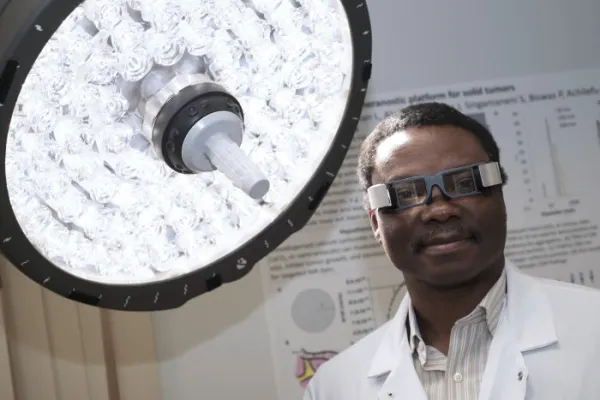
The technology has continued to evolve. The most recent version, described in a 2026 paper in npj Imaging, includes dual green alignment lasers that converge when the device is positioned at the correct working distance. This ensures consistent data acquisition regardless of who is operating the device. A Bluetooth foot pedal allows hands-free control. The system is battery-powered and wearable, eliminating the need for a cart-based system that takes up space in the operating room.
Clinical testing has been promising. In a study comparing CVG to FDA-approved systems, the goggles achieved comparable or superior tumor contrast with high spatial overlap. Unlike handheld systems, CVG maintained stable fluorescence detection from 10 to 60 cm, enabling reproducible quantitative imaging across a broad working-distance range. The system also demonstrated the ability to find satellite tumors that other imaging might miss.

The implications are significant. Cancer that has spread remains the major reason patients die. Removing all traces of a tumor reduces the risk of recurrence and the need for future surgeries. The Cancer Vision Goggles give surgeons a tool to see what they were previously missing, in real time, without the bulk and cost of conventional systems.
Achilefu’s work has been recognised at the highest levels. In February 2025, he was elected to the National Academy of Engineering, one of the highest professional distinctions accorded to an engineer. He became the first UT Southwestern faculty member to achieve this honour . He was elected to the National Academy of Medicine in 2021 and as a Fellow of the National Academy of Inventors in 2018 . He has received more than 20 national and international honours, including the Britton Chance Award in Biomedical Optics and the St. Louis Award.
He has also been elected a Fellow of the Royal Society of Chemistry, Optica (formerly OSA), SPIE, the American Association for the Advancement of Science, the American Institute for Medical and Biological Engineering, and the Royal Society of Medicine.
Despite his achievements, Achilefu has said he hopes his story inspires children in the developing world to pursue their talents. He was one of them. Born in Nigeria, educated in France, and now a leader in American biomedical engineering, he represents a path that many children in the developing world might not imagine for themselves.

The Cancer Vision Goggles are not yet standard equipment in every operating room. But they represent a shift in how surgery can be performed: less invasive, more precise, and more accessible. They are a testament to what happens when a scientist asks a simple question and refuses to accept the limitations of existing technology.
Samuel Achilefu asked: could we use night-vision technology to make cancer visible? The answer, it turns out, is yes. And it came from a man who grew up in a war-torn Nigeria and never stopped looking for a way to help others see.
Sources:
- Zhang, H., Xu, X., Ta, C., et al. “Bridging preclinical and clinical fluorescence-guided surgery with advanced cancer vision goggles.” npj Imaging, 2026. https://doi.org/10.1038/s44303-026-00170-x
- UT Southwestern Medical Center, “Samuel Achilefu, Ph.D., elected to National Academy of Engineering,” 13 February 2025. https://www.utsouthwestern.edu/newsroom/articles/year-2025/feb-achilefu-elected-nae.html
- UT Southwestern Medical Center, “With innovation of Medical Vision Goggles, no cancer cells left behind,” 6 May 2025. https://utswmed.org/medblog/medical-vision-goggles-cancer/
- Siteman Cancer Center, “Achilefu named to chemistry, optical societies.” https://siteman.washu.edu/achilefu-named-to-chemistry-optical-societies/
- Siteman Cancer Center, “Developer of Cancer Goggles Hopes to Inspire Children in the Developing World to Pursue Their Talents,” 2 February 2016. https://siteman.wustl.edu/27437-2/
- Vanguard News, “Meet Dr. Samuel Achilefu, Nigerian doctor who invented first cancer visualization goggles,” 30 November 2024. https://www.vanguardngr.com/2024/12/meet-dr-samuel-achilefu-nigerian-doctor-who-invented-first-cancer-visualization-goggles/
- UT Southwestern Research Labs, “Meet Dr. Achilefu.” https://labs.utsouthwestern.edu/achilefu-lab/lab-members-and-alumni/meet-dr-achilefu
- 8. ORCID, Samuel Achilefu (0000-0002-3133-6717). https://orcid.org/0000-0002-3133-6717
Verification Table
| Key Fact | Source & Context | Status |
| Samuel Achilefu was born in 1963 in northern Nigeria | Vanguard ; Siteman Cancer Center ; Connectnigeria | Verifiable |
| His family moved to southeast Nigeria during the Nigerian Civil War when he was five | Vanguard ; Connectnigeria | Verifiable |
| He earned his PhD and conducted postdoctoral research | Siteman Cancer Center ; UT Southwestern | Verifiable |
| He is the inaugural Chair of Biomedical Engineering at UT Southwestern Medical Center | UT Southwestern | Verifiable |
| He holds the Lyda Hill Distinguished University Chair in Biomedical Engineering | UT Southwestern | Verifiable |
| He developed the Cancer Vision Goggles (CVG) | Nature ; UT Southwestern ; NPJ Imaging | Verifiable |
| The goggles use near-infrared fluorescence and augmented reality | UT Southwestern ; Nature | Verifiable |
| A dye is injected that attaches to cancer cells, which glow under NIR light | UT Southwestern | Verifiable |
| The goggles overlay glowing tumor images onto the surgeon’s real-time view | UT Southwestern | Verifiable |
| The system is battery-powered, wearable, and single-operator | IEEE ; Nature | Verifiable |
| CVG maintained stable fluorescence detection from 10 to 60 cm | NPJ Imaging | Verifiable |
| Clinical trials showed performance equivalent to FDA-approved systems | NPJ Imaging | Verifiable |
| ClinicalTrials.gov: NCT05576974 (registered 04/08/2025) | NPJ Imaging | Verifiable |
| He was elected to the National Academy of Engineering in 2025 | UT Southwestern | Verifiable |
| He is the first UT Southwestern faculty member elected to NAE | UT Southwestern | Verifiable |
| He is a member of the National Academy of Medicine | UT Southwestern ; ORCID | Verifiable |
| He is a Fellow of the National Academy of Inventors | UT Southwestern | Verifiable |
| He holds more than 70 U.S. patents | UT Southwestern | Verifiable |
| He has published more than 300 scientific papers | UT Southwestern | Verifiable |
| He received the Distinguished Investigator Award from the DoD Breast Cancer Research Program | UT Southwestern | Verifiable |
| He is a Fellow of the Royal Society of Chemistry | Siteman ; UT Southwestern | Verifiable |
| He is a Fellow of Optica (formerly OSA) | Siteman ; UT Southwestern | Verifiable |
| He is a Fellow of SPIE | UT Southwestern | Verifiable |
| He is a Fellow of the American Association for the Advancement of Science | UT Southwestern | Verifiable |
| He is a Fellow of the American Institute for Medical and Biological Engineering | UT Southwestern | Verifiable |
| He is a Fellow of the Royal Society of Medicine | UT Southwestern | Verifiable |
Achievements, Awards & Commemorations
| Achievement | Date | Details |
| National Academy of Engineering | February 2025 | Elected for contributions to molecular imaging of cancer and nanotherapeutics; first UT Southwestern faculty member to receive this honour |
| National Academy of Medicine | 2021 | Elected as member |
| National Academy of Inventors | 2018 | Elected as Fellow |
| Herman Beerman Award | 2024 | Society for Investigative Dermatology |
| Weinbaum Award | 2024 | Rensselaer Polytechnic Institute |
| Britton Chance Award in Biomedical Optics | 2019 | SPIE |
| Carl and Gerty Cori Faculty Achievement Award | 2018 | Washington University in St. Louis |
| St. Louis Award | 2015 | Greater St. Louis City and County |
| Medical Inventor Award | 2014 | St. Louis Business Journal |
| Distinguished Investigator Award | Undated | Department of Defense Breast Cancer Research Program; first recipient |
| Royal Society of Chemistry Fellow | Undated | Elected Fellow |
| Optica (OSA) Fellow | Undated | Elected Fellow |
| SPIE Fellow | Undated | Elected Fellow |
| AAAS Fellow | Undated | Elected Fellow |
| AIMBE Fellow | Undated | Elected Fellow |
| Royal Society of Medicine Fellow | Undated | Elected Fellow |
| U.S. Patents | Ongoing | More than 70 patents awarded |
| Scientific Publications | Ongoing | More than 300 papers published |