
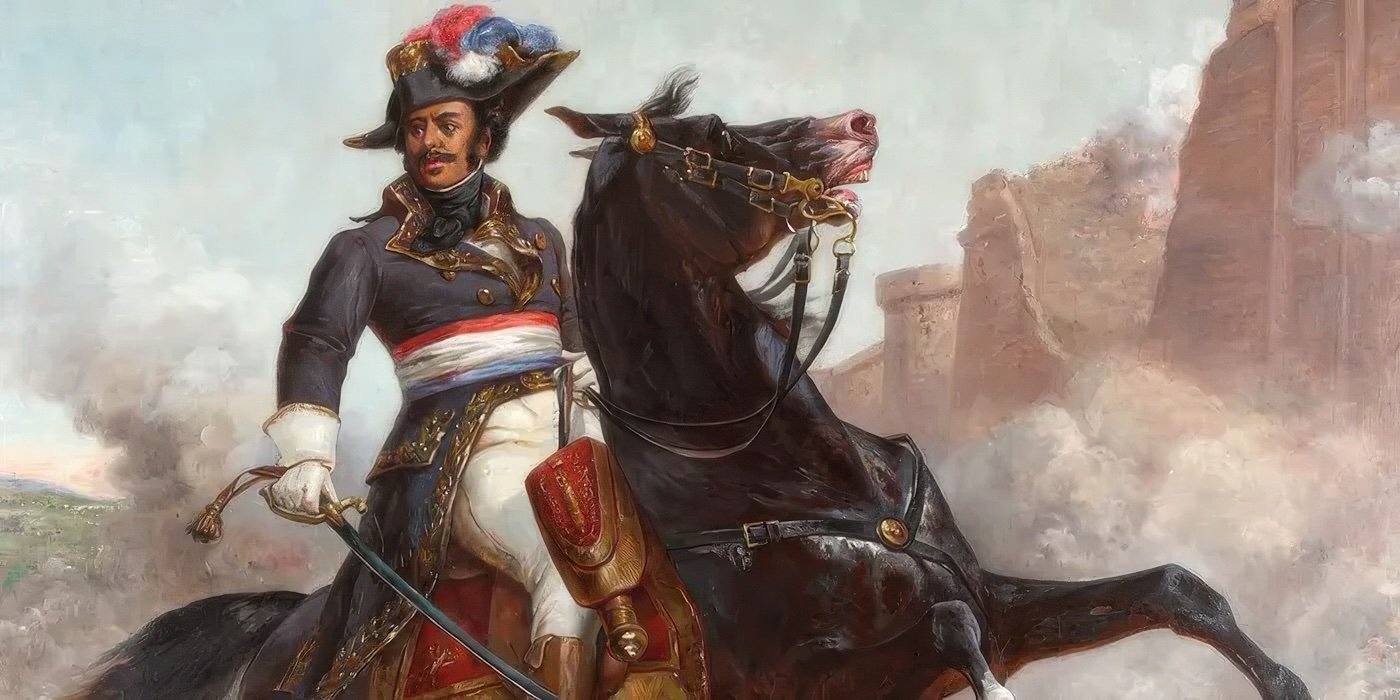
Thomas-Alexandre Dumas was born on 25 March 1762, on the island of Saint-Domingue, in a world defined by sugar, slavery, and the brutal economics of empire. His father, Alexandre Antoine Davy de la Pailleterie, was a French nobleman. His mother, Marie-Cessette Dumas, was an enslaved African woman.
He was born into bondage. But he did not stay there.
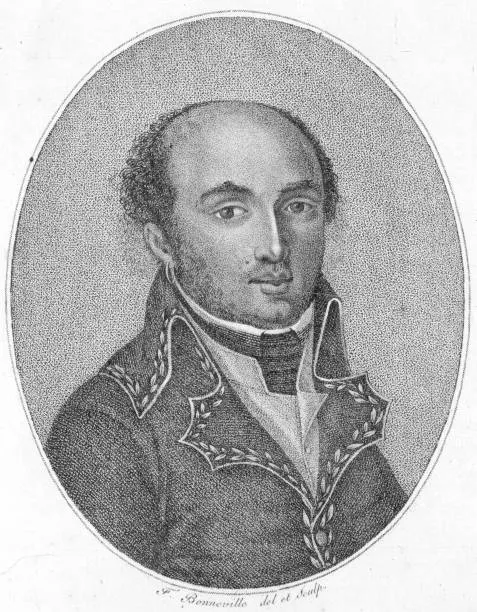
At fourteen, his father brought him to France. The young Thomas-Alexandre was educated in a military academy in Paris and entered the military, as was expected of a nobleman’s son. But his path was complicated by the circumstances of his birth. Had his mother been white, he would have inherited his father’s title and noble status. He could not. He was mixed-race, and the laws of the ancien régime limited his opportunities.
In 1786, after a falling-out with his father, Thomas-Alexandre enlisted as a private in the French army. He chose to serve under his mother’s name: Dumas. He joined the Dragons de la Reine as a simple cavalier, with no commission, no title, no privilege.
Then the Revolution came.
The French Revolution transformed the army. Birth and nobility mattered less. Merit and courage mattered more. Dumas rose fast. By 1792, he was a lieutenant-colonel in the Black Legion. By September 1793, he was a general of division, the first descendant of Africans to achieve that rank in France . He fought in the Alps, where he distinguished himself in the capture of the Petit-Saint-Bernard and Mont-Cenis passes. He was awarded a sword of honour and 10,000 livres for exceptional bravery in 1797.
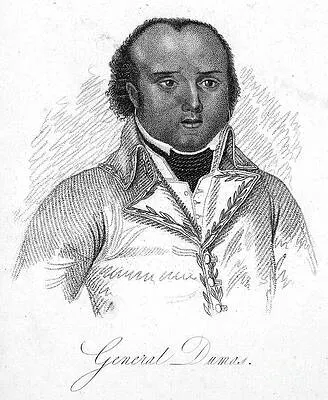
In 1798, Dumas accompanied Napoleon to Egypt. He commanded the cavalry of the Orient. He fought in the desert. He was, by all accounts, one of the most effective officers in the campaign. He became known as “the Black Devil” for his ferocity in battle.
But the relationship between Dumas and Napoleon soured. In 1799, Dumas left Egypt without the general’s permission. Napoleon never forgave him. Years later, Napoleon reportedly said he would have made Dumas a duke, but he never did.
On his voyage home, Dumas was captured by Neapolitan forces. He was imprisoned for two years in southern Italy, in conditions that destroyed his health. He was “severely mistreated, even tortured.” When he returned to France in 1801, he was “crippled, almost paralysed, and with a stomach ulcer”.
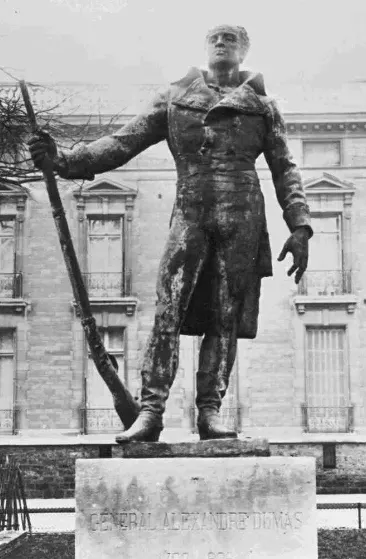
He petitioned for his back pay—28,500 francs owed from his captivity—and for a pension. He was denied both. The French Ministry of Defence records that “certain authors see in this the personal action of Bonaparte” . He was placed on forced retirement in September 1802. He died on 26 February 1806, in Villers-Cotterêts, at the age of 43, “in a certain destitution”.
The context of Napoleon’s hostility was racial and political. In May 1802, Napoleon reinstated slavery in the French colonies, reversing the 1794 abolition . He imposed harsh racial laws and began purging Black and mixed-race officers from the military. Dumas was offered a command to suppress Toussaint Louverture’s revolution in Saint-Domingue. He refused. According to the historian Claude Ribbe, he said: “Citizen Consul, you forget that my mother was a negress. How could I obey you? I am of negro origin. I will not bring chains and dishonor to my native land and to men of my race”.
Napoleon had Toussaint arrested and imprisoned at Fort de Joux, where he died in April 1803. Dumas was left to waste away in retirement, his health ruined, his career ended, his pay denied.
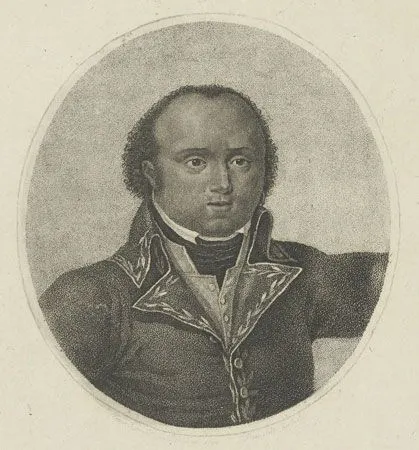
His son, Alexandre Dumas, was three years old when he died. The younger Alexandre grew up hearing stories about his father. He heard about the strength, the courage, the charges, the battles. He heard about the imprisonment, the injustice, the fall from grace. And he turned those stories into some of the most popular novels ever written.
The Three Musketeers (1844) is a swashbuckling adventure of loyalty and bravery. The Count of Monte Cristo (1844-1846) is the story of a man unjustly imprisoned who returns to take his revenge. Scholars agree: the character of the Count, and the heroism of the musketeers, came directly from the life of General Thomas-Alexandre Dumas.
General Dumas was born enslaved. He became the highest-ranking Black officer in the French army. He served under Napoleon. He refused to fight his own people. He was imprisoned, abandoned, and died in poverty. And his son made him immortal.
The life of Thomas-Alexandre Dumas is a story about the limits of revolution, the persistence of racism, and the power of a son’s love. It is also one of the great untold stories of Black history in Europe. A man who should be remembered not only as the father of a famous writer, but as a hero in his own right.
Sources:
- John G. Gallaher, General Alexandre Dumas: Soldier of the French Revolution (Google Books)
- Michigan State University, “Dumas, Thomas-Alexandre.” African Studies Center.
- Bibliothèque nationale de France, Catalogue général: Dumas, Thomas Alexandre.
- BlackPast.org, “Thomas-Alexandre Dumas (1762–1806).”
- Claude Ribbe, “Le général Dumas (1762-1806),” Cairn.info
- French Ministry of Defence, “DAVY DE LA PAILLETERIE Thomas-Alexandre dit « Général Dumas » (1762-1806)”
- Kirkus Reviews, “THE BLACK COUNT” (2012)
- Assemblée nationale, “1802-1804 – Rétablissement progressif de l’esclavage”
- Retronews, “1802 : Quand Bonaparte rétablissait l’esclavage en France”
- Ministère de la Culture, “Les 220 ans de Toussaint Louverture”
Verification Table
| Key Fact | Source & Context | Status |
| Born Thomas-Alexandre Davy de la Pailleterie on 25 March 1762 in Jérémie, Saint-Domingue | BnF; Slovak National Library | Verifiable |
| Father: Alexandre Antoine Davy de la Pailleterie, French nobleman | Google Books | Verifiable |
| Mother: Marie-Cessette Dumas, enslaved African woman | Google Books | Verifiable |
| Taken to France by his father at age 14 (1776) | Google Books | Verifiable |
| Educated in a military academy in Paris | Google Books | Verifiable |
| Enlisted as a private in 1786 under name “Dumas” (mother’s surname) | Google Books | Verifiable |
| Joined the Dragons de la Reine as a simple cavalier | French Ministry of Defence | Verifiable |
| Rose rapidly during the French Revolution | Google Books | Verifiable |
| Became a general by 1793 | French Ministry of Defence | Verifiable |
| Served under Napoleon in Egypt | Google Books | Verifiable |
| Left Egypt in 1799 against Napoleon’s wishes | Google Books | Verifiable |
| Napoleon never forgave him and continued to punish his family after death | Google Books | Verifiable |
| Imprisoned in southern Italy until 1801 | Google Books | Verifiable |
| Died 26 February 1806 in Villers-Cotterêts | CCFr ; French Ministry of Defence | Verifiable |
| Died in poverty, unable to obtain pension | CCFr ; French Ministry of Defence ; Google Books | Verifiable |
| Denied back pay and pension, attributed to Napoleon’s personal action | French Ministry of Defence ; Google Books | Verifiable |
| Son Alexandre Dumas was 3 years old at his father’s death | CCFr | Verifiable |
| Alexandre Dumas wrote The Three Musketeers and The Count of Monte Cristo | CCFr; IMDb | Verifiable |
| Dumas’s life inspired his son’s novels | MSU | Verifiable |
| Napoleon reinstated slavery in French colonies in 1802 | Assemblée nationale ; Retronews | Verifiable |
| Napoleon purged Black officers from the military | Claude Ribbe ; Kirkus Reviews | Verifiable |
| Napoleon imprisoned Toussaint Louverture | Ministry of Culture ; Radio France | Verifiable |
| Toussaint died in Fort de Joux in 1803 | Ministry of Culture | Verifiable |
| Dumas refused command to suppress Toussaint’s revolution | Claude Ribbe | Verifiable |
| Dumas was offered command to repress the Haitian insurrection | Claude Ribbe | Verifiable |
| Dumas’s refusal linked to his mother’s African origin | Claude Ribbe | Verifiable |
Achievements, Awards & Commemorations
| Achievement | Date | Details |
| General of Division | 3 September 1793 | Highest rank achieved in French army; first descendant of Africans to obtain this grade |
| Commander-in-Chief of the Army of the Alps | December 1793 | Appointed by letter from Paris |
| Sword of Honour and 10,000 livres gratuity | March 1797 | Awarded for exceptional feats of arms against the Austrians |
| Commander of the Cavalry of the Orient | 1798 | Chosen by Bonaparte for the Egyptian expedition |
| Military Reputation | 1790s | Earned reputation for bravery and strength; nicknamed “the Black Devil” |
| Literary Legacy | 1844-1846 | Son’s novels The Three Musketeers and The Count of Monte Cristo inspired by his life |
| Statue in Paris | 1913 | Monument to General Dumas erected in Place Malesherbes (destroyed 1943, melted down by Nazi occupation) |
| Plaque at Villers-Cotterêts | Present | Commemorative plaque at his place of death |
| Avenue du Général Dumas | Present | Street named in his honour in Paris |